Before the Tree Goes Up: A Ten-Minute Check for Christmas Lights and Extension Leads
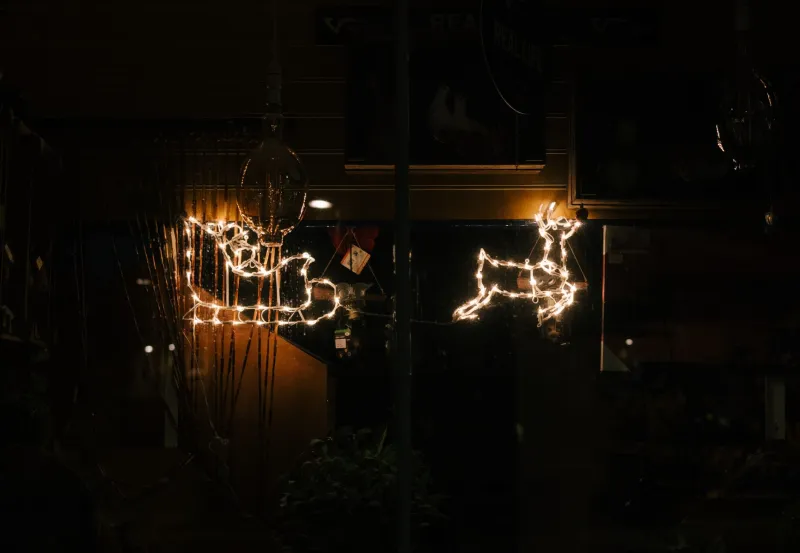
It's the same ritual every year. The lights come down from the loft in a bin bag, get plugged in on the kitchen floor, and roughly half of them work. Then comes forty minutes of bulb-swapping on a set that was probably due for retirement a decade ago.
Before the step ladder comes out, give yourself ten minutes. Not to turn the house into a light show — just to deal with the handful of things that genuinely cause problems in December. Here's what we look at.
Start at the plug, not the tree
Pick up each set and look at the plug end first. You want a proper moulded BS 1363 plug, no cracks in the casing, no scorching around the pins, and a fuse that matches the set. Small light sets usually want a 3A fuse; if someone has shoved a 13A in there because it was the only one in the drawer, that's worth correcting.
If a plug has been replaced with something taped up, or the set came from abroad with an adaptor permanently attached, treat it as scrap. Christmas lights are cheap. House fires are not.
Press the RCD button — it takes ten seconds
Your consumer unit should have an RCD, usually identifiable by a test button marked 'T' or 'Test'. Press it. It should trip and cut the power to the circuits it protects. Reset it, and you're done.
If nothing happens, that's a real problem and one worth sorting before you add outdoor lights, extension leads and a house full of guests to the equation. Give us a call — a dead RCD means the safety net isn't there.
Understand your IP rating, because 'weatherproof' means nothing
Outdoor lights should carry an IP rating. The two digits cover dust and water; for anything living outside in a British winter, IP44 is the sensible minimum, and IP65 is better for anything fully exposed.
What matters just as much is where the connections sit. Even a well-rated set will misbehave if the transformer is lying in a puddle or the joint is sitting in wet grass. Get connections up off the ground, ideally under cover, and use an outdoor socket with its own RCD protection rather than trailing an indoor extension lead out of the back door.
One lead, one job
Daisy-chaining extension leads is the single most common thing we see and the easiest thing to avoid. Each joint adds resistance and heat, and the whole lot is still limited by the fuse in the first plug — usually 13A, so around 3kW.
A few habits worth keeping:
- Don't plug one extension lead into another, however tempting the reach.
- Unwind cable reels fully before use. A coiled reel under load gets hot.
- Skip the stacked multi-way adaptors. One block adaptor feeding two more is asking for trouble.
- Don't run leads through a window or under a door where the cable gets pinched.
- Keep cables out from under rugs and away from where people walk.
Do a quick sum on what you're plugging in
LED sets are modest — a typical 200-light string draws perhaps 6W, so running it for six hours a night through December costs pence, not pounds. Older incandescent sets are a different animal and can pull far more for the same effect.
Either way, don't hang a fan heater, an electric fire or a big set of halogen floods off the same lead as the tree. Lighting circuits are often 6A, and sockets on a ring main are shared with everything else in the room. If the plug or socket feels warm to the touch after an hour, that's your answer.
Water, ladders and gutters
Outdoor lights near gutters and downpipes are fine, but clip the cable rather than draping it over metalwork, and keep ladders clear of overhead cables and the service head. Never hang lights from a cable you can't identify, and never drape anything over the supply coming into the house.
If an outdoor socket trips whenever it rains, that's not bad luck — it's water getting in somewhere it shouldn't.
When a set should go in the bin
Retire it, don't repair it, if you spot any of these:
- Flickering that continues after you've reseated the bulbs
- Scorch marks, melted plastic or a burning smell
- Exposed conductors anywhere along the cable
- Cracked lampholders or a plug that wobbles
- Taped-up damage, or a previous repair with insulating tape
- Cables that are stiff, cracked or sticky to the touch
- Anything so old it has no BS EN number on the label
- Bulbs that keep blowing — usually a sign the set itself is failing
Flickering isn't just annoying. It often means a poor connection, and a poor connection means heat.
The ten-minute checklist
- Press the RCD test button and reset it.
- Check every plug for cracks, scorching and the right fuse.
- Unwind any cable reel before it goes under load.
- Confirm outdoor sets and connections are IP44 or better and off the ground.
- Bin any set with damage, tape or a smell.
- Add up what's running on each lead — heaters and lights don't share.
- Put the tree lights on a timer plug so they're not on all night.
When to call an electrician
Most festive lighting is genuinely DIY-safe if you use your eyes and don't overload things. Get someone qualified involved if the RCD won't trip or keeps tripping, if a socket or plug is warm or discoloured, if you can smell burning, if an outdoor socket trips in wet weather, or if you're considering permanent outdoor sockets and lighting rather than a temporary lash-up.
That last one is worth planning properly, and it means next December takes about five minutes instead of an afternoon.